Deciding How to Address a Concerning Tree
Tree Pruning and Removal in Dallas for structural correction, clearance needs, dead growth, or hazardous trees that require professional evaluation
A mature tree in Highland Park or University Park may develop dead limbs over a roofline, crossing branches that rub and create wounds, or a lean that suggests root compromise. Advanced Tree & Shrub Care, Inc evaluates trees across North Texas to determine whether pruning addresses the concern or whether removal is the more appropriate decision. Pruning corrects structure, removes dead or damaged growth, provides clearance from buildings and utilities, and reduces weight on over-extended limbs, while removal becomes necessary when a tree is dead, severely diseased, structurally unsound, or positioned where it cannot be retained safely. You request an evaluation so that someone with arboricultural knowledge can assess the tree's condition and explain what options are realistic.
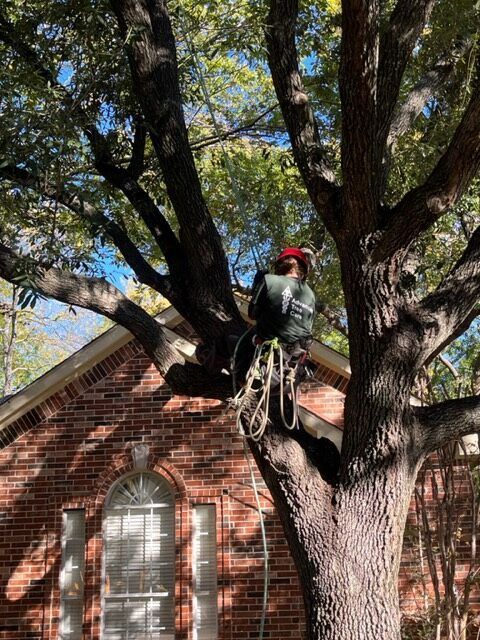
Pruning involves selective cuts that remove specific branches while preserving the tree's natural form and structural integrity. Proper cuts are made just outside the branch collar, allowing the tree to compartmentalize the wound and continue growing. Removal takes down the entire tree when its condition or location makes retention impractical or unsafe.
Request an evaluation to discuss the tree's condition and determine whether pruning or removal is the better approach.
Why Proper Pruning Works for Long-Term Health
Pruning focuses on maintaining the tree's natural shape and preserving structural integrity rather than creating a cosmetic silhouette. A broccoli cut removes interior branches and concentrates foliage only at limb ends, creating a rounded, tufted appearance that weakens the tree over time. Removing too much inner growth reduces the leaf surface area necessary for photosynthesis, limiting the tree's ability to produce energy and recover from stress. The remaining outer foliage becomes heavier and more prone to wind damage because the natural branch structure that provides internal support has been compromised, and weakly attached regrowth increases the risk of limb failure.
After proper pruning, dead wood is removed, clearance is established around structures, and the tree retains a balanced canopy that distributes weight and wind load effectively. Cuts heal cleanly, and the tree continues to grow without the structural imbalance that shortens lifespan and increases failure risk during North Texas storms.
Removal is appropriate when a tree is dead, hollow, heavily infested, or leaning with compromised roots. Trees that interfere with construction, utility work, or access may also need to be taken down even if they are otherwise healthy. The decision depends on the tree's condition, location, and whether the problems can be managed through pruning or require complete removal.
Common Questions About This Service
Property owners in established North Texas neighborhoods often ask how to distinguish between pruning situations and removal situations before committing to either approach.
How do I know if my tree needs pruning or removal?
Pruning is appropriate when the tree is structurally sound but has dead branches, crossing limbs, clearance issues, or weight imbalance. Removal is necessary when the tree is dead, extensively decayed, severely leaning, or poses a hazard that cannot be corrected through selective cutting.
What is a broccoli cut and why should it be avoided?
A broccoli cut removes interior branches and leaves foliage concentrated only at limb ends, creating a rounded appearance that looks tidy initially but weakens the tree structurally. This practice reduces photosynthetic capacity, encourages weak regrowth, and increases the risk of limb failure during high winds common in Dallas and surrounding areas.
When is the best time to prune trees in North Texas?
Late winter and early spring are generally preferred for structural pruning because trees are dormant and wounds compartmentalize effectively before the growing season. Dead wood can be removed any time, and clearance pruning can be done as needed to address immediate concerns.
What happens to the tree after removal?
The tree is cut down in sections, and debris is removed from the property. The stump remains unless grinding is scheduled separately. Removal eliminates the hazard and clears the space, but it does not include replanting or landscape restoration.
Can a tree that is leaning be pruned instead of removed?
It depends on why the tree is leaning and whether the root system is still secure. Advanced Tree & Shrub Care, Inc evaluates root condition, trunk integrity, and soil stability to determine if pruning can reduce weight and make the tree safer or if the lean indicates failure that requires removal.
Advanced Tree & Shrub Care, Inc evaluates trees across Dallas, Plano, Frisco, Richardson, and the broader North Texas region. Request an evaluation to discuss the tree's condition and determine the most appropriate course of action based on what the assessment reveals.