
Structural Support for Compromised Trees
Cabling in Dallas for weak branches, split trunks, or leaning stems that require supplemental support to reduce failure risk
Support cables reinforce tree structure when branches, co-dominant stems, or trunks develop weaknesses that make failure likely during high winds or storms. Trees in North Texas face severe thunderstorms and wind events that expose structural defects, and cabling provides supplemental support that reduces the load on weak unions or over-extended limbs. Advanced Tree & Shrub Care, Inc installs cabling systems for trees that have value worth preserving but need reinforcement to remain safe around homes, buildings, or high-use areas in Dallas and surrounding communities. You notice the tree has a split trunk, a heavy limb extending over a structure, or a lean that suggests the root system is struggling to support the canopy, and cabling is evaluated as a way to extend the tree's useful life while managing the risk.
Cabling involves installing high-strength cable between limbs or stems to limit movement and distribute stress during wind loading. The cable is anchored through hardware installed in the tree, and the system is tensioned to provide support without restricting natural sway entirely. Not all weak limbs are suitable for cabling, and the tree's overall condition determines whether the system will provide meaningful benefit or whether removal is the safer long-term decision.
Arrange a consultation to discuss the tree's structure and determine whether cabling is appropriate for the specific defect affecting stability.
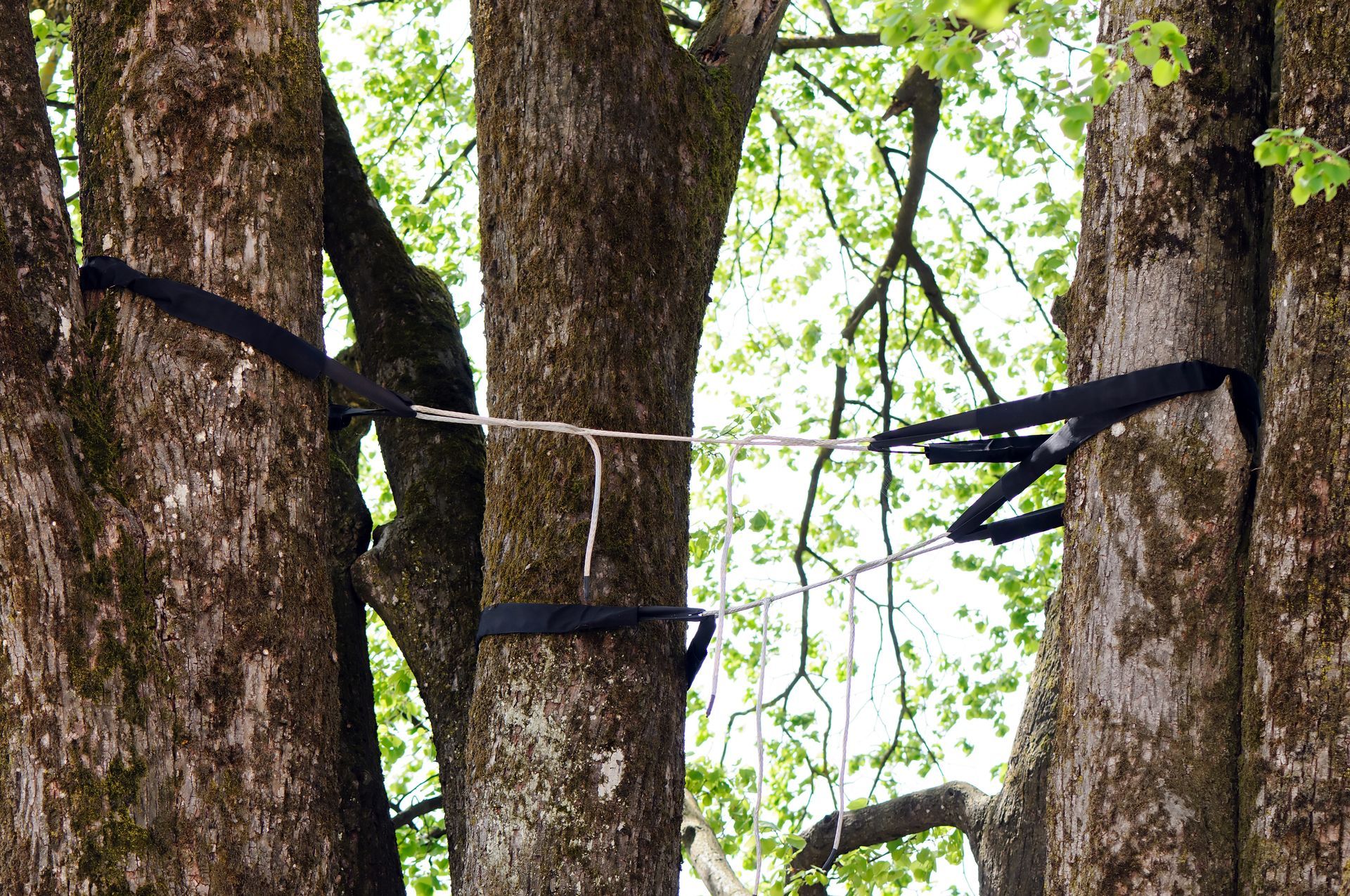
What Changes After Cabling Is Installed
The cable restricts how far the limbs or stems can move apart during wind loading, reducing the stress on the weak union or attachment point. This does not eliminate the defect, but it lowers the likelihood of sudden failure during storms. Trees with co-dominant stems that have included bark between the trunks are especially prone to splitting, and cabling limits the movement that causes the union to tear apart under load. Cables can also reposition limbs away from structures, reducing the risk of contact during sway.
After installation, the tree remains standing with reduced failure risk, and the cable system requires periodic inspection to verify that hardware remains secure and that the tree has not outgrown the installation. Cabling does not repair the underlying weakness, and it does not make a compromised tree as reliable as a structurally sound tree. The system buys time and reduces risk, but it does not eliminate the need for ongoing monitoring.
Cabling is not appropriate for trees that are already extensively decayed, for limbs that are too small to anchor hardware safely, or for trees that are too far compromised to justify the installation cost. The effectiveness of cabling depends on the tree's condition, the severity of the defect, and whether the rest of the tree is healthy enough to benefit from the support. Advanced Tree & Shrub Care, Inc uses high-quality, durable cabling products to provide the best outcome when the tree is a suitable candidate for supplemental support.
What Property Owners Usually Ask
Tree owners often ask about suitability, effectiveness, and maintenance requirements before committing to a cabling installation on a valuable or high-risk tree.
What kinds of trees benefit from cabling?
Trees with co-dominant stems, weak branch unions, heavy limbs extending over structures, or trunks that are splitting but still structurally viable are common candidates. The tree must have enough healthy tissue to anchor the hardware, and the defect must be one that cabling can realistically reinforce.
How does cabling reduce failure risk during storms?
The cable limits how far the limbs or stems can move apart when wind loads the canopy, reducing stress on the weak attachment point. This does not prevent all failure, but it significantly lowers the likelihood of the union splitting or the limb tearing off during severe weather events common in Dallas and surrounding areas.
Does cabling need to be inspected after installation?
Yes, the system should be inspected periodically to verify that hardware remains secure, that the cable has not been overtaken by bark growth, and that the tree's condition has not deteriorated to the point where the cabling is no longer effective. Advanced Tree & Shrub Care, Inc recommends follow-up evaluations after major storms or every few years as part of routine tree care.
Can cabling save a tree that is already leaning severely?
It depends on whether the root system is still anchored and whether the trunk is structurally sound. Cabling is not a substitute for root stability, and a tree that is uprooting or has extensive root decay may need removal regardless of supplemental support installed in the canopy.
What are the limitations of cabling?
Cabling does not repair decay, eliminate disease, or restore structural integrity. It provides supplemental support for a specific defect, but it does not make the tree as reliable as one without structural problems. Some trees are too compromised to justify cabling, and a professional arborist must assess whether the installation is worthwhile based on the tree's overall condition.
Advanced Tree & Shrub Care, Inc evaluates trees for cabling across Dallas, Highland Park, University Park, Richardson, and the broader North Texas region. Consult with the company to assess the tree's structure and discuss whether supplemental support is appropriate for the defect affecting stability.