
Structural Support That Keeps Trees Stable
Bolting in Fairview for trees with weak unions, split trunks, or limbs at risk of failure
Advanced Tree & Shrub Care, Inc installs steel bolts through structural weak points in trees where multiple leaders or heavy limbs create failure risk. This hardware stabilizes the tree from the inside, preventing further splitting while allowing the wood to continue growing around the installation. Property owners throughout Fairview rely on this technique when removing a valuable tree isn't the preferred option but leaving it untreated creates liability.
The service addresses trees with co-dominant stems that share bark inclusions, old storm damage that left partial splits, or limbs that carry weight beyond what the attachment point can safely support. Each installation involves drilling precisely through the trunk or limbs at calculated angles, then threading and tightening galvanized or stainless steel bolts to redistribute mechanical stress away from the weak union.
Schedule an on-site evaluation to determine whether your tree's structure requires bolting or alternative stabilization methods.
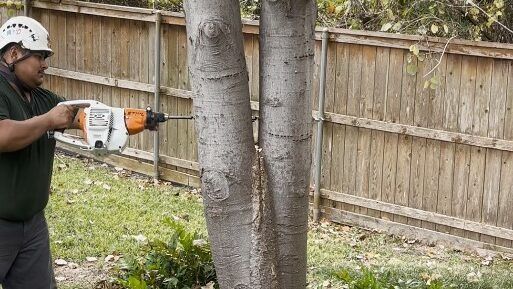
What Proper Bolting Requires
The process begins with a structural assessment to identify the exact location where the tree's wood fibers are failing or at risk of separating. Arborists measure the diameter of the trunk or limbs, calculate the appropriate bolt size and length, and determine the drilling angle that will pass through the center of both sections without damaging critical cambium layers. The bolts are installed with washers sized to distribute pressure evenly across the bark surface, preventing the hardware from cutting into the tree as it continues to expand.
After the bolts are tightened, you'll notice the visible gap in a split trunk closes, or the sway in a heavy limb decreases significantly during windstorms. The tree no longer flexes at the weak point in ways that tear wood fibers incrementally with each gust. Bolting doesn't reverse existing damage, but it stops the progression of splitting and allows the tree to compartmentalize the injury over time, sealing off the damaged area with new growth.
This technique works best when combined with regular pruning to reduce end weight on the supported limb and periodic inspections to confirm the hardware remains properly tensioned. It's not suitable for trees with advanced decay at the union point, where the wood lacks sufficient sound material to hold the bolt securely.
Common Questions About This Service
Fairview property owners often ask about hardware placement, inspection schedules, and when bolting makes sense compared to cabling or removal.
What types of trees benefit most from bolting?
Trees with co-dominant stems that form a narrow V-shaped crotch are the most common candidates, especially species like oak, elm, and pecan that develop heavy horizontal limbs. The technique is effective when the split or weak union hasn't progressed to the point where decay has compromised the surrounding wood.
How does bolting differ from cabling?
Bolting uses rigid steel rods installed through the trunk or limbs to prevent movement at the weak point, while cabling uses flexible steel cables installed higher in the canopy to limit the range of motion between leaders. Bolting addresses unions that are already splitting or under severe stress, whereas cabling prevents future failures in structurally sound but mechanically disadvantaged limbs.
When should bolts be inspected after installation?
Initial inspection occurs within the first year to confirm the tree is responding well and the hardware hasn't loosened, then every two to three years as part of routine tree health evaluations. Advanced Tree & Shrub Care, Inc checks for signs of girdling where the bolt contacts bark and verifies that the supported union shows no new cracking.
What happens if a bolted tree continues to split?
If decay was already present in the wood at installation or if the tree experiences trauma beyond what the hardware can stabilize, the split may continue despite bolting. In those cases, the service provided time to plan for removal or allowed the tree to remain stable long enough to complete other landscape projects before addressing it.
Can bolts be removed if the tree heals?
Once installed, bolts remain in place permanently because removing them creates new wounds and eliminates the structural support the tree has adapted to. The tree grows around the hardware over time, and the bolts become an integrated part of the tree's mechanical system.
Advanced Tree & Shrub Care, Inc handles urgent tree hazards across Dallas, Highland Park, University Park, and the broader North Texas region. Call the company directly when a tree failure creates immediate risk to property or access.